Top articles
- Alumina Ceramic Wear Liners: Technical Selection and Application for Industrial Wear Protection
- Wear-Resistant Ceramic Tiles for Agitator Tank Protection
- High-Quality Alumina Ceramic Manufacturing Process: From Powder to Finished Product
- Design of Alumina Ceramic Liner Installation Structures and Key Technical Points for Failure Prevention
- Alumina Wear-Resistant Ceramics: The Hardcore Armor of Industry
- Impact Resistance of Ceramic Rubber Vulcanized Plates: An In-Depth Analysis
- What Is Alumina Ceramic and Why Is It the Preferred Wear-Resistant Material for Industry?
- Wear-Resistant Ceramic Tiles: Industrial Wear Protection Solution
- New Benchmark in Impact Resistance and Wear Protection:Three-in-One Ceramic Vulcanized Liners
- Wear-Resistant Ceramic Liners for Cyclone Separators
Latest articles
- Alumina Ceramic Wear Liners: Technical Selection and Application for Industrial Wear Protection
- Wear-Resistant Ceramic Tiles for Agitator Tank Protection
- High-Quality Alumina Ceramic Manufacturing Process: From Powder to Finished Product
- Design of Alumina Ceramic Liner Installation Structures and Key Technical Points for Failure Prevention
- Alumina Wear-Resistant Ceramics: The Hardcore Armor of Industry
- Impact Resistance of Ceramic Rubber Vulcanized Plates: An In-Depth Analysis
- What Is Alumina Ceramic and Why Is It the Preferred Wear-Resistant Material for Industry?
- Wear-Resistant Ceramic Tiles: Industrial Wear Protection Solution
- New Benchmark in Impact Resistance and Wear Protection:Three-in-One Ceramic Vulcanized Liners
- Wear-Resistant Ceramic Liners for Cyclone Separators
Your browsing history

Alumina Ceramic Wear Liners: Technical Selection and Application for Industrial Wear Protection
In material handling and grinding systems, steel equipment surfaces are continuously subjected to sliding abrasion, particle erosion, and impact. Liners function as replaceable protective layers, and the material selection directly affects equipment availability and maintenance economics. Alumina ceramic wear liners, manufactured from high-purity alumina through forming and high-temperature sintering, offer well-defined engineering advantages in hardness, wear resistance, and chemical stability. They have become a mainstream wear protection solution for ball mills, chutes, hoppers, and conveying pipelines.
The core performance of alumina ceramic wear liners originates from the intrinsic properties of the ceramic phase. High-purity alumina ceramics achieve a Mohs hardness of 9 and a bulk density typically no lower than 3.60 g/cm³, with some high-purity grades exceeding 3.68 g/cm³. This hardness level is substantially higher than that of manganese steel, Ni-hard cast iron, and most metallic wear materials, significantly reducing the cutting and ploughing effect of abrasive particles on the ceramic surface.
In terms of chemical stability, alumina ceramics exhibit good resistance to acids, alkalis, and salt media, making them suitable for wet grinding and corrosive slurry environments. They do not generate metallic debris during service and therefore introduce no iron or heavy-metal contamination into the processed material. This property carries clear process value in lithium battery cathode materials, fine ceramics, and high-purity mineral processing.
Primary Application Scenarios
1.Ball Mill Liners
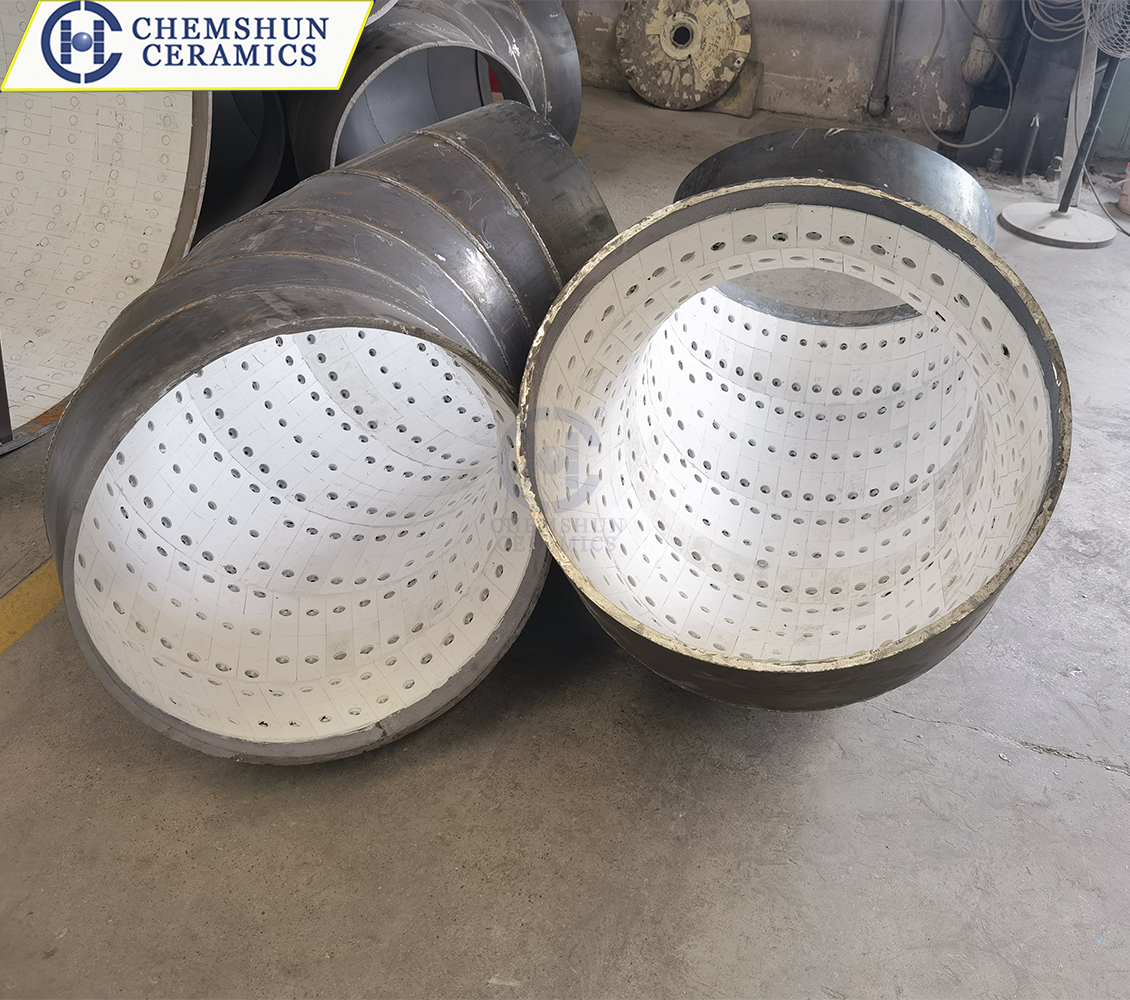
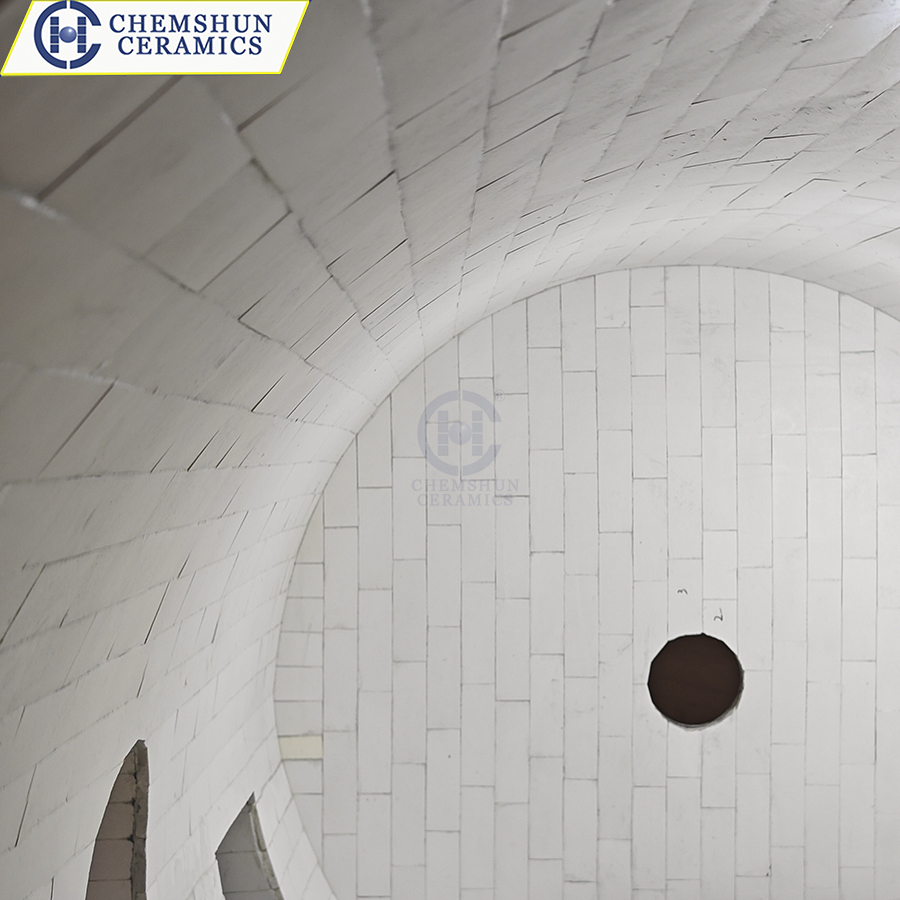
In mining, cement, and powder processing, ball mill shells experience continuous impact and abrasion from grinding media and materials. Alumina ceramic lining bricks—arranged in square, trapezoidal, or curved profiles—isolate the steel shell from direct contact with the grinding charge, reducing shell wear rates and preventing iron contamination. Compared with conventional metallic liners, ceramic liners typically offer longer replacement intervals under equivalent abrasive conditions, helping to reduce shutdown frequency for maintenance.
2.Material Handling and Transfer Equipment.
Steel walls in chutes, hoppers, transfer points, cyclones, and dust collection ducts are prone to thinning under continuous sliding and impact from bulk or granular materials. Ceramic liners are installed on these surfaces by bonding, welding, or bolting to form a high-hardness wear layer. Composite structures—ceramic tiles bonded to a steel backing plate—further simplify installation and replacement, particularly in applications where the dominant wear mechanism is sliding abrasion.
Selection and Installation Considerations
The engineering effectiveness of ceramic liners depends on the match between material parameters and operating conditions. Selection should consider alumina content, bulk density, flexural strength, and tile dimensions, with the fixing method determined by equipment geometry, material particle size, and impact energy. For locations subject to large-lump impact, toughened ceramics or composite structures may be specified to balance wear resistance and impact tolerance.
Installation quality directly influences liner service life. Ceramic tiles should conform closely to the equipment surface with tight arrangement and uniform joints, and the adhesive must be compatible with operating temperature and media conditions. For rotating equipment, the effect of liner weight on equipment load and fastener reliability must also be considered. A sound installation scheme combined with a periodic inspection regime is essential for maintaining the protective function of the liner over time.