

The performance variance of high-quality alumina ceramics originates primarily from engineering precision across powder preparation,forming control,sintering schedule,and finished-product inspection,rather than from formulation alone. The following sections describe the complete manufacturing route of industrial-grade alumina ceramics in process order.
1.Powder Preparation and Formulation Control
The performance baseline of alumina ceramics is determined by powder purity. Industrial products are classified by alumina content into 95%,99%,and higher-purity grades,each with distinct impurity tolerances. Alkali oxides (Na2O,K2O),silica,and iron oxide are the primary controlled species,as their levels directly affect sintering behavior and the final microstructure. Incoming powder is sampled and tested for main content and impurity levels before release to batching.
Batching and Mixing Homogeneity
The batching step meters alumina powder and sintering aids according to the target grade. Sintering aids regulate the densification path: some promote particle rearrangement through liquid-phase formation,others alter lattice diffusion rates via solid solution,and some inhibit grain-boundary migration to control grain coarsening. The mixing operation requires homogeneous distribution of additives at both macroscopic and microscopic scales to prevent internal stresses and property scatter arising from localized differences in sintering behavior.
2.Forming
Dry Pressing
Dry pressing is employed for volume production of standard tiles, liners, and regular geometries. Powder is subjected to uniaxial pressure in a die, consolidating into a green body with a defined shape and initial density. The engineering requirements are uniform pressure distribution and defect-free ejection; excessive pressure gradients leave density gradients within the green body that can translate into deformation or cracking during sintering.
Isostatic Pressing
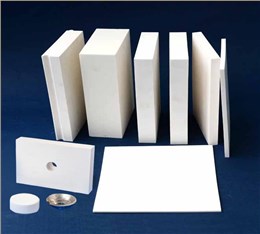 Ceramic Tile Liner
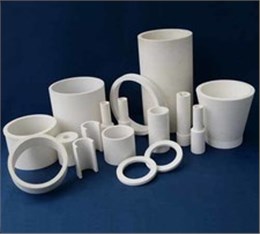 Alumina Ceramic Pipe Liner
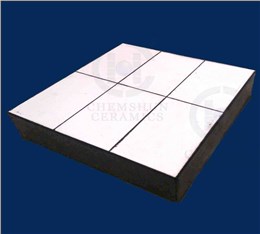 AL92 Ceramic Rubber Chute Liner
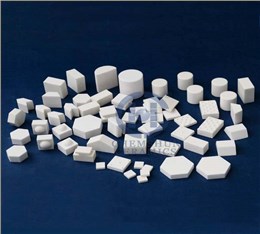 Wear Resistant Ceramic Liner